Tranquil Travels is a transit app concept for autistic travelers. Our team of five turned expert interviews and community research into priorities, then revised the navigation in response to participant feedback.
My role
From research to design requirements.
I owned requirements and prioritization. I synthesized the research into a ranked set of product requirements and adjusted them when participant feedback changed our priorities. I worked with Jennifer Purington, Ky’mani Brown, Mark D’Antonio, and Winter Graham on the five-person team.
Research
Transit is hard to predict.
Unexpected changes and sensory overload can make public transit difficult for autistic travelers. We wanted to understand what an app would need to do before and during a trip.
We interviewed autism-research specialists Ann Marie Orlando and Nigel Newbutt, then reviewed five videos and more than 100 community posts across Reddit, YouTube, and Facebook.
What we found
Overload, change, and coping.
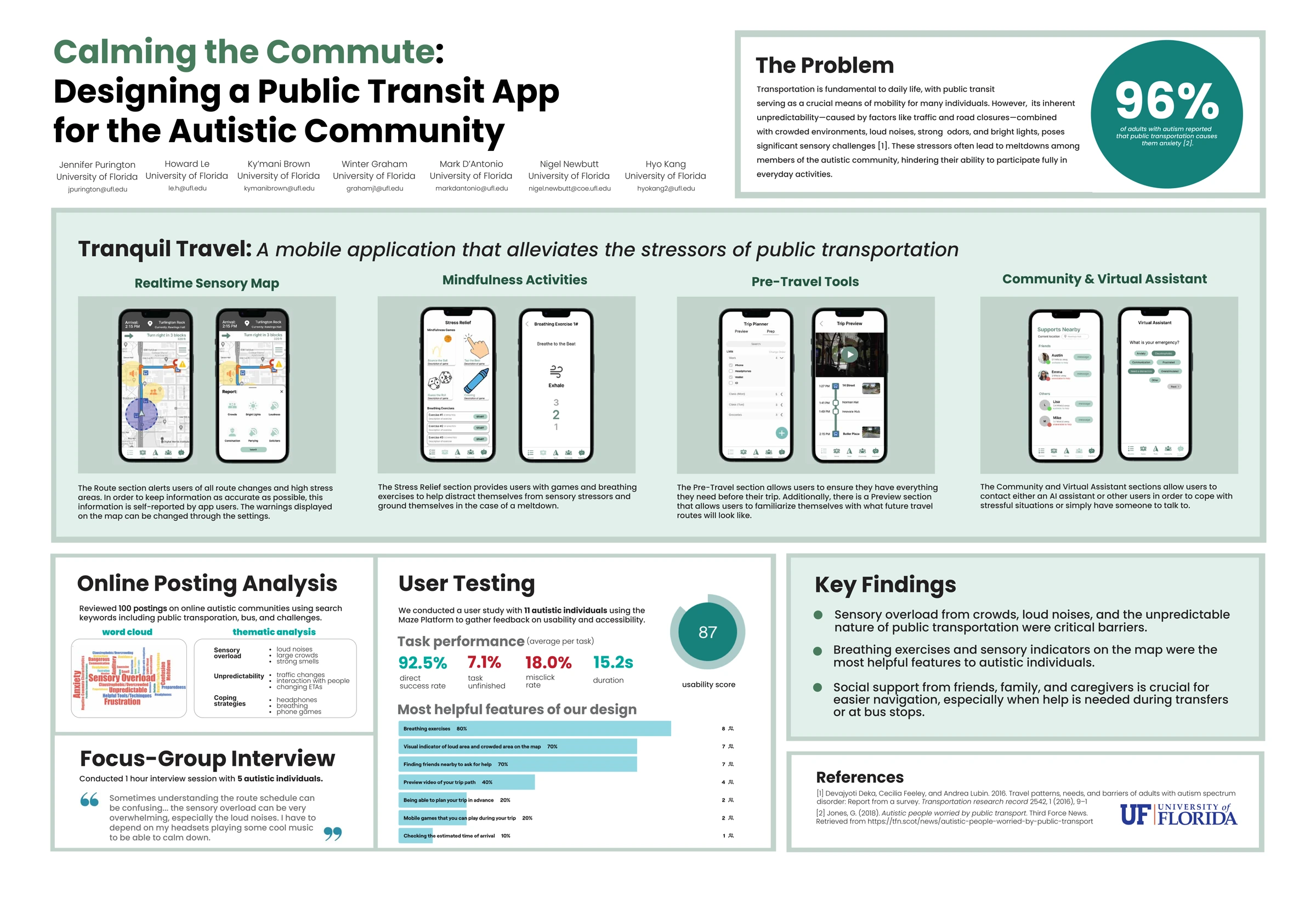
Using MAXQDA for thematic analysis, we identified sensory overload, unexpected changes, and the coping strategies people already used. The team’s research poster highlights crowds, loud noises, and unpredictable transit as recurring barriers. It also identifies breathing exercises and sensory indicators as useful coping supports, alongside personal support when navigating transfers or bus stops.
Research themes and related requirements.
This synthesis pairs sensory overload, unexpected changes and coping strategies with related features in the concept.
Requirements
Recovery before speed.
We prioritized predictability and recovery over finding the fastest route. The concept needed to explain what would happen next and give a traveler a clear option when the plan changed.
Design for one specific journey
Our persona was a UF student who wanted to travel to class independently. That kept the requirements focused on a specific journey.
Give a route change a next step
Route previews and quieter alternatives addressed the uncertainty we saw in the research. Breathing exercises offered an optional coping aid.
Feedback revised the requirements. The surviving source lists requirements without ranks; the animation shows feedback that brought Community into the main navigation.
An initial structure with four support areas.
The original application map grouped features under trip planning, the current route, stress relief, and help; Community was not yet a main destination.
Design decisions
Prepare ahead. Stay oriented.
The team translated the requirements into a high-fidelity prototype. Hazard reporting, quieter-route alternatives, and coping activities were proposed features rather than a live transit service.
Decision 1: Separate Preview from Prep
The trip planner separates understanding the route from getting ready to leave. A route preview helps travelers anticipate unfamiliar surroundings, while a packing checklist helps them check their belongings before departure. Both respond to the research priority of predictability.
Preview and Prep
The Prep tab turns getting ready into a checklist, separate from the route preview.
Decision 2: Show sensory reports on the map
The map places reported sensory conditions beside the route. Travelers can report stressors such as noise or crowds, helping others anticipate potentially overwhelming areas. These are proposed community reports in the prototype, rather than a live source of transit conditions.
Sensory notes along the route.
Reported sensory conditions appear beside the route in the proposed map interface.
Decision 3: Keep coping aids optional
The Stress Relief area offers games and breathing exercises, reflecting coping strategies identified in the research. These activities remain optional and reachable from the main navigation. Community and virtual-assistant concepts provide additional ways to seek support, recognizing that people have different communication preferences.
An optional coping aid
A dedicated support area gives travelers access to optional breathing exercises.
Decision 4: Let travelers choose what they share
The profile and settings concept lets travelers choose which sensory stressors trigger notifications and whether they appear on the map for others to message. This gives users control over the warnings they receive and whether they participate in nearby support.
Feedback
Feedback changed navigation and reporting.
Early focus-group feedback called for clearer navigation and easier access to support. Some participants wanted help from a real person during stressful journeys, so the Community concept let travelers find and message people nearby. I updated the requirements, and the team brought Community into the main navigation.
Make reporting easier to recognize
Participants also struggled to identify the sensory-reporting control. The team redesigned it to look more clearly like a button, making the reporting action easier to recognize. This gave us a specific interaction to improve alongside the broader navigation changes.
Reporting control, before and after
The bare warning icon on the map became the same icon on a white button. Original prototype screens; the close-up compares both controls at the same scale.
Before feedback
The initial structure gave Community lower priority than planning, routing, stress relief, and help.
Revised navigation
Community now sits in the bottom navigation beside planning, route navigation, stress relief, and assistance.
What we asked people to do
We tested three tasks in Maze: report a loud noise through hazard reporting, open a route preview from the trip planner, and complete a breathing exercise starting from the home screen. The original team poster documents a study with 11 autistic participants and reports a usability score of 87. Its task-performance averages were 92.5% direct success, 7.1% unfinished, an 18.0% misclick rate, and a 15.2-second duration. These are prototype-study results averaged per task, rather than results from real transit journeys.
Outcome
A prototype for preparation and recovery.
The project produced a high-fidelity prototype and research-grounded requirements for preparation, sensory awareness, coping, and support. The team poster reports a Maze usability score of 87 and 92.5% direct success. The 18.0% misclick rate also leaves room to improve interaction clarity. These results describe prototype tasks; real journeys remain untested.
What I would test next
I would test route changes with autistic travelers in real transit settings, with appropriate support, to understand where the guidance helps and where it adds work.
Original team research poster · January–April 2024. Select the image to enlarge.
Reflection
Feedback can reorder priorities.
Community moved from a secondary feature into the main navigation after participant feedback. I learned to revisit the requirements when feedback challenges the original hierarchy.
Prototype tasks are not real trips.
The Maze tasks explored whether people could find and use specific features. Whether the concept helps during an actual journey is still an open question.
Product demo
See the prototype in motion.
Walk through trip preparation, route information, and the prototype’s support features.